
What is pun? Learn the meaning of puns, how they work, and discover 21 funny examples that make wordplay clever, memorable, and entertaining. What Is Pun
What Is Pun? A Complete Guide with Examples
Have you ever laughed at a joke because a word had two meanings? Or noticed a clever caption that made you smile because it played with language? If so, you’ve already experienced a pun.
Many people ask, what is pun, especially when they encounter witty captions, jokes, memes, or social media posts. Understanding puns can help you appreciate humor, improve your writing, and create more engaging content. What Is Pun
Answer Box
A pun is a form of wordplay that uses multiple meanings of a word or similar-sounding words to create humor, wit, or a clever effect. Puns are commonly used in jokes, captions, advertisements, literature, and everyday conversations because they make language more memorable and entertaining.
What Is Pun?
A pun is a literary device and type of joke that relies on words with multiple meanings or words that sound alike.
The goal is simple: create a humorous or clever effect by playing with language.
Simple Definition
A pun occurs when a speaker or writer intentionally uses a word or phrase that can be interpreted in more than one way.
Example:
“I used to be a banker, but I lost interest.”
The humor comes from the word “interest,” which can mean:
- Financial earnings
- Personal enthusiasm
This dual meaning creates the joke.
Why Are Puns So Popular?
Puns have remained popular for centuries because they:
✅ Make people laugh
✅ Improve memorability
✅ Add creativity to writing
✅ Increase engagement on social media
✅ Enhance advertising campaigns
In the USA, UK, Ireland, and Canada, puns frequently appear in marketing slogans, newspaper headlines, and Instagram captions because they quickly grab attention.
Types of Puns
1. Homophonic Puns
These use words that sound alike but have different meanings.
Example:
“Time flies like an arrow; fruit flies like a banana.”
2. Homographic Puns Mood Instagram Captions
These use words spelled the same way but with different meanings.
Example:
“The fisherman was hooked on fishing.”
3. Compound Puns
These combine multiple puns in one sentence.
Example:
“A bicycle can’t stand on its own because it’s two-tired.”
4. Visual Puns
These use images instead of words to create a joke.
They’re commonly used in memes and advertisements.
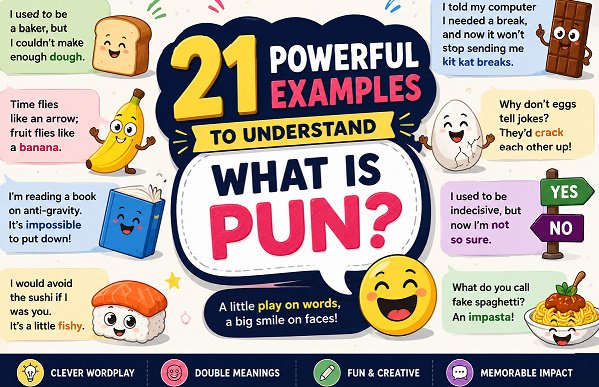
21 Funny Pun Examples
Here are some of the best examples to understand what is pun:
- I’m reading a book about anti-gravity. It’s impossible to put down.
- I used to be a baker, but I couldn’t make enough dough.
- The scarecrow won an award because he was outstanding in his field.
- I wondered why the baseball kept getting bigger. Then it hit me.
- I’m friends with all electricians. We have great current connections.
- The math teacher has too many problems.
- I’m on a seafood diet. I see food and I eat it.
- The calendar’s days are numbered.
- The bicycle fell over because it was two-tired.
- A boiled egg every morning is hard to beat.
- The musician got into treble.
- I used to play piano by ear. Now I use my hands.
- The librarian booked a vacation.
- The shoe factory manager got cold feet.
- The dentist had a filling experience.
- The gardener planted the idea.
- The coffee was strong enough to espresso itself.
- The fisherman got hooked.
- The computer needed more bytes.
- The clock was time-consuming.
- The photographer developed a negative attitude.
Pun vs Joke: What’s the Difference?
| Feature | Pun | Traditional Joke |
| Uses wordplay | Yes | Not always |
| Depends on double meanings | Yes | Sometimes |
| Usually short | Yes | Often longer |
| Focuses on language | Yes | Focuses on story |
| Easy to use in captions | Yes | Less common |
How to Create Your Own Puns
Creating puns is easier than most people think.
Step 1: Find a Keyword
Choose a word with:
- Multiple meanings
- Similar-sounding alternatives
Step 2: Explore Word Associations
Example:
Word: “Current”
Possible meanings:
- Electricity
- Present time
Step 3: Build a Clever Sentence
“We have a current relationship.”
Step 4: Test for Clarity
The best puns are:
- Easy to understand
- Short
- Relevant to the audience
Pro Tip: The “DMS Framework” for Creating Viral Puns
Most articles stop at definitions. Here’s a practical framework used by content creators.
D – Double Meaning
Choose a word with at least two meanings.
M – Match Context
Connect that word to your topic.
S – Surprise Ending
Deliver an unexpected twist.
Example:
Topic: Coffee
Double Meaning: “Grounds”
Pun: “I have solid grounds for loving coffee.”
This framework helps create memorable captions, headlines, and social media content.
Puns in Social Media Captions
Puns work exceptionally well on Instagram, Facebook, and TikTok because they increase engagement.
Examples:
📸 “Orange you glad I posted this?”
📸 “Donut worry, be happy.”
📸 “I’m soy into you.”
📸 “Lettuce celebrate.”
📸 “You’re one in a melon.”
Funny Puns Collection 2026
Famous Pun Examples in Advertising
Many brands use puns because they improve recall.
Examples include:
- Food campaigns
- Restaurant slogans
- Travel advertisements
- Retail promotions
Research consistently shows that humorous and memorable messaging improves audience engagement and brand recognition.
Common Mistakes When Using Puns
Avoid these mistakes:
❌ Making the pun too complicated
❌ Using obscure words
❌ Overusing puns in every sentence
❌ Ignoring audience understanding
❌ Sacrificing clarity for cleverness
Quick Checklist for Great Puns
Before publishing, ask:
- Is the pun easy to understand?
- Does it relate to the topic?
- Is it short and memorable?
- Will the audience recognize the wordplay?
- Does it enhance the message?
If you answer yes to all five, your pun is probably effective.
Key Takeaways: what is pun
- A pun is a type of wordplay using multiple meanings or similar-sounding words.
- Puns create humor and make content memorable.
- They are commonly used in jokes, captions, advertising, and literature.
- Understanding what is pun helps improve creativity and communication.
- The DMS Framework can help anyone create effective puns quickly.
- Short, clear puns usually perform best on social media.
Conclusion
Now that you understand what is pun, you can recognize them in jokes, captions, advertisements, and everyday conversations. Puns may seem simple, but they’re one of the most effective forms of humor because they combine creativity, language, and surprise. What Is Pun
Whether you’re writing Instagram captions, creating content, or simply trying to make friends laugh, mastering puns can make your communication more engaging and memorable. What Is Pun
Ready to discover even more clever wordplay? Explore our growing collection of funny puns and caption ideas today!
[…] https://fbcaptionsbangla.online/what-is-pun/ […]